AI in 2026 is the most dangerous technology humanity has approached, Bill Gates warns
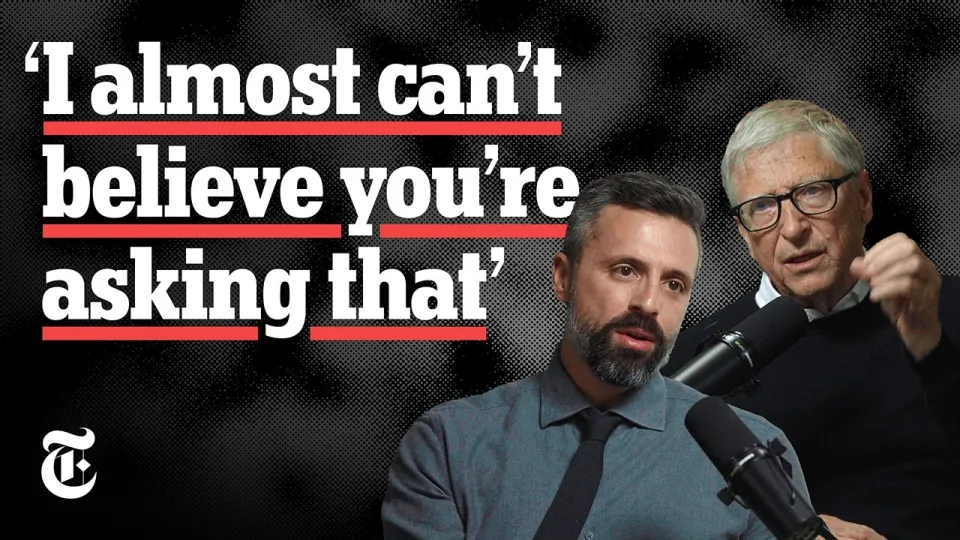
Video: Bill Gates: A.I. ‘Makes Nuclear Weapons Look Like Nothing’ | The Ezra Klein Show
You can order the same kind of articles for your own video to boost it on YouTube and Google. Just message the Telegram bot @sat_sit_bot. Articles with your video embedded are written and posted by the bot itself — on popular topical sites (no ads). Free trial — 50 articles.
· based on the channel The Ezra Klein Show
Key takeaways
- Gates calls AI the most dangerous thing humans have ever gone near, saying it makes nuclear weapons look like nothing.
- He identifies two hard thresholds — cyberattacks and bioterrorism — where damage becomes catastrophic before regulation catches up.
- Gates calls the idea that the AI industry can self-regulate "insane" and argues lawsuits cannot answer a mass-casualty event.
- The Gates Foundation, set to spend down roughly $200 billion over two decades, now treats AI-driven inequality as a core priority.
- He warns of mass job loss and proposes taxing AI labor and reserving some roles for humans.
Bill Gates argues that AI in 2026 is the most dangerous technology humanity has ever approached, and that the danger is larger than most alarmists admit. In a conversation with Ezra Klein, he says the coming years will bring catastrophic cyberattacks, bioterrorism and mass job loss unless governments act, and he calls the belief that the AI industry can regulate itself "insane." The full interview is available in the New York Times opinion podcast transcript.
What Bill Gates actually said about AI risk
Gates frames AI risk as a problem of speed rather than of malice. The core claim is that capability is advancing faster than the institutions meant to contain it, so the window between a dangerous capability appearing and a policy response arriving is measured in months, not decades. He points to two thresholds that matter more than general warnings: cyber offense, where models can find and exploit vulnerabilities at machine speed, and bio, where model assistance could lower the skill barrier for producing dangerous pathogens. In both cases the harm is not gradual — it arrives as a single event with mass casualties.
His comparison to nuclear weapons is deliberately uncomfortable. Nuclear risk, in his framing, is at least bounded by physical supply chains, treaties and visible facilities. Software and biology have no equivalent chokepoints, which is why he describes AI as making nuclear weapons look like nothing. The people in positions of authority, he suggests, are in denial about how close those thresholds are.
Why industry self-regulation fails on AI
Self-regulation fails on AI because the incentives of the companies building the systems and the incentives of the public do not align. Gates is blunt about this: expecting firms to slow their own frontier work while competitors accelerate is not a safety strategy, it is a hope. The interview's sharpest exchange comes when he dismisses the idea of resolving a mass-casualty failure through litigation — a lawsuit arrives years after the damage and cannot restore what was lost.
A useful way to think about his argument is as three separate failures:
- Speed mismatch. Model capabilities change in weeks; legislation and standards move in years.
- Measurement gap. Companies grade their own homework on dangerous capability evaluations, and there is no independent body with access to the weights.
- Liability gap. Courts assign fault after harm, which is the wrong tool for events that are irreversible.
His conclusion is that government has to set hard thresholds — capability evaluations, deployment gates and audit rights — before models cross into cyber or bio risk, not after.
The race with China and the cost of slowing down
Gates treats the US–China dynamic as the strongest argument against pausing, and also the reason pausing unilaterally is unlikely. If one country steps back from frontier development, the other continues, and the safety benefit evaporates while the strategic cost stays. That logic pushes toward coordinated limits and shared evaluation standards rather than a single-nation moratorium.
This is where the interview gets uncomfortable for readers who want a simple answer. Gates does not claim regulation is costless or that slowing down is safe. He claims the alternative — racing without thresholds — is worse, and that the race is already close enough that coordination has to happen while capability is still measurable.
Jobs, wages and the no-scarcity labor market
Mass job loss is the second pillar of Gates's warning, and his framing goes beyond the usual "some jobs will change." He describes a labor market where AI removes scarcity from cognitive work, which pressures wages across white-collar roles faster than new categories of work appear. The transition, not the endpoint, is the problem: displaced workers need income before retraining pays off.
His proposals are concrete and controversial. One is taxing AI labor — treating automated output as a taxable base so that public revenue does not collapse as payrolls shrink. Another is designating certain roles as "human reserved," where a person must be in the loop by law, similar to safety-critical professions. He also points to AI as a tool for language preservation and access in regions that never had enough teachers or translators, and to the risk that developing economies get the disruption without the capital.
What the skeptical questions get right
Skeptics in the audience raise fair points, and the interview is stronger for addressing them. The most common objection is that Gates sounds more alarmed than the technologists actually shipping the systems, and that market incentives have historically corrected harmful products. The counterargument in the conversation is that market correction requires visible harm and consumer choice, and neither exists for a model that can be misused by a single actor before anyone notices.
Another recurring doubt is whether regulation can work at all when model weights can be copied and open-source releases cross borders instantly. Gates's answer leans on compute and training-run visibility rather than on controlling every download: the largest training runs are detectable, and that is where the gates can be placed.
A third question is about his own position. He is a major philanthropic funder with ties to the industry, and he acknowledges the tension rather than dodging it, arguing that the foundation's new focus on AI and inequality is a response to what he sees coming, not a substitute for policy.
Education, children and the inequality test
Education is where Gates's optimism and his alarm meet. He sees AI tutors as a genuine equalizer for students in under-resourced schools, and he also flags learning loss in rich countries where devices arrived without pedagogy. The policy ask is narrow: default protections for minors, age-appropriate design rules and clear limits on data collection from children.
The inequality test runs through the whole conversation. Gates says the Gates Foundation, which is set to spend down roughly $200 billion over the next two decades, now treats making AI a force for equality as a core priority. His sharpest line is about distance: inequity persists because the people who could fix it are far from the people living with it, and AI compresses that distance in both directions.
Useful links
- Full transcript of the Bill Gates interview on The Ezra Klein Show
- Book recommendations from guests of The Ezra Klein Show
The bottom line on AI risk
Gates's message is not that AI should be stopped but that it is being deployed without the institutions needed to catch a catastrophic failure. His specific asks — independent capability evaluations, deployment gates for cyber and bio risk, taxes on automated labor and reserved human roles — are the actionable part of a conversation that is otherwise a warning. The discomfort in the interview comes from his insistence that the people with authority to act are not treating the timeline as urgent. This analysis draws on the conversation published by The Ezra Klein Show, which remains the best source for the full argument in Gates's own words; the transcript is here.
Source: Bill Gates: A.I. ‘Makes Nuclear Weapons Look Like Nothing’ | The Ezra Klein Show · Markdown version
Questions & answers
Why does Bill Gates compare AI to nuclear weapons?
He argues that nuclear risk is bounded by physical supply chains, treaties and visible facilities, while AI and biological capabilities have no equivalent chokepoints. A single actor with model access can cause mass harm, which is why he says AI makes nuclear weapons look like nothing.
What does Gates propose instead of industry self-regulation?
He wants government-set thresholds: independent capability evaluations, deployment gates before models cross into cyber or bio risk, and audit rights for regulators. He dismisses lawsuits as a remedy because they arrive years after irreversible harm.
Will AI cause mass job loss?
Gates warns that AI removes scarcity from cognitive work and pressures white-collar wages faster than new roles appear. He proposes taxing AI labor and designating certain jobs as human reserved so income support arrives before retraining does.
Is regulation realistic if the US and China are racing each other?
Gates treats the race as the main reason unilateral pauses fail, since one country stepping back hands the advantage to the other. He argues for coordinated limits and shared evaluation standards, placed where large training runs are detectable.